Desktop Extensions:为 Claude Desktop 提供一键安装 MCP 服务器
Desktop Extensions: One-click MCP server installation for Claude Desktop
文章目录
—
—
When we released the Model Context Protocol (MCP) last year, we saw developers build amazing local servers that gave Claude access to everything from file systems to databases.
当我们在去年发布 Model Context Protocol (MCP) 时,我们看到开发者构建了出色的本地服务器,让 Claude 能够访问从文件系统到数据库的各种内容。
But we kept hearing the same feedback: installation was too complex.
但我们不断听到同样的反馈:安装过于复杂。
Users needed developer tools, had to manually edit configuration files, and often got stuck on dependency issues.
用户需要开发者工具,必须手动编辑配置文件,并且经常卡在依赖问题上。
Today, we're introducing Desktop Extensions—a new packaging format that makes installing MCP servers as simple as clicking a button.
今天,我们推出 Desktop Extensions——一种新的打包格式,让安装 MCP 服务器像点击按钮一样简单。
Addressing the MCP installation problem
解决 MCP 安装问题
Local MCP servers unlock powerful capabilities for Claude Desktop users.
本地 MCP 服务器为 Claude Desktop 用户解锁了强大的能力。
They can interact with local applications, access private data, and integrate with development tools—all while keeping data on the user's machine.
它们可以与本地应用程序交互、访问私有数据,并与开发工具集成——同时将数据保留在用户机器上。
However, the current installation process creates significant barriers:
然而,当前的安装流程造成了重大障碍:
Developer tools required: Users need Node.js, Python, or other runtimes installed
需要开发者工具:用户需要安装 Node.js、Python 或其他运行时
Manual configuration: Each server requires editing JSON configuration files
手动配置:每个服务器都需要编辑 JSON 配置文件
Dependency management: Users must resolve package conflicts and version mismatches
依赖管理:用户必须解决包冲突和版本不匹配问题
No discovery mechanism: Finding useful MCP servers requires searching GitHub
没有发现机制:寻找有用的 MCP 服务器需要在 GitHub 上搜索
Update complexity: Keeping servers current means manual reinstallation
更新复杂:让服务器保持最新意味着手动重新安装
These friction points meant that MCP servers, despite their power, remained largely inaccessible to non-technical users.
这些摩擦点意味着,MCP 服务器尽管功能强大,对非技术用户来说仍然基本无法使用。
Introducing Desktop Extensions
推出 Desktop Extensions
Desktop Extensions (.mcpb files) solve these problems by bundling an entire MCP server—including all dependencies—into a single installable package.
桌面扩展(Desktop Extensions,即 .mcpb 文件)通过将整个 MCP server——包括所有依赖项——打包到单个可安装包中,解决了这些问题。
Here's what changes for users:
对用户而言,变化如下:
Before:
之前:
# Install Node.js first
npm install -g @example/mcp-server
# Edit ~/.claude/claude_desktop_config.json manually
# Restart Claude Desktop
# Hope it worksAfter:
之后:
Download a .mcpb file
下载一个 .mcpb 文件
Double-click to open with Claude Desktop
双击以通过 Claude Desktop 打开
Click "Install"
点击“Install”
That's it.
就是这样。
No terminal, no configuration files, no dependency conflicts.
没有终端,没有配置文件,没有依赖冲突。
Architecture overview
架构概览
A Desktop Extension is a zip archive containing the local MCP server as well as a manifest.json, which describes everything Claude Desktop and other apps supporting desktop extensions need to know.
Desktop Extension 是一个 zip 归档,包含本地 MCP 服务器以及一个 manifest.json,后者描述了 Claude Desktop 和其他支持桌面扩展的应用需要知道的一切。
extension.mcpb (ZIP archive)
├── manifest.json         # Extension metadata and configuration
├── server/               # MCP server implementation
│   └── [server files]
├── dependencies/         # All required packages/libraries
└── icon.png             # Optional: Extension icon

# Example: Node.js Extension
extension.mcpb
├── manifest.json         # Required: Extension metadata and configuration
├── server/               # Server files
│   └── index.js          # Main entry point
├── node_modules/         # Bundled dependencies
├── package.json          # Optional: NPM package definition
└── icon.png              # Optional: Extension icon

# Example: Python Extension
extension.mcpb (ZIP file)
├── manifest.json         # Required: Extension metadata and configuration
├── server/               # Server files
│   ├── main.py           # Main entry point
│   └── utils.py          # Additional modules
├── lib/                  # Bundled Python packages
├── requirements.txt      # Optional: Python dependencies list
└── icon.png # Optional: Extension iconThe only required file in a Desktop Extension is a manifest.json.
Desktop Extension 中唯一必需的文件是 manifest.json。
Claude Desktop handles all the complexity:
Claude Desktop 负责处理所有复杂细节:
Built-in runtime: We ship Node.js with Claude Desktop, eliminating external dependencies
内置运行时:我们在 Claude Desktop 中附带 Node.js,从而消除了外部依赖
Automatic updates: Extensions update automatically when new versions are available
自动更新:当有新版本可用时,扩展会自动更新
Secure secrets: Sensitive configuration like API keys are stored in the OS keychain
安全机密:像 API key 这样的敏感配置存储在操作系统密钥链中
The manifest contains human-readable information (like the name, description, or author), a declaration of features (tools, prompts), user configuration, and runtime requirements.
manifest 包含人类可读的信息(如名称、描述或作者)、功能声明(工具、提示词)、用户配置以及运行时要求。
Most fields are optional, so the minimal version is quite short, although in practice, we expect all three supported extension types (Node.js, Python, and classic binaries/executables) to include files:
大多数字段都是可选的,因此最小版本相当简短,不过在实践中,我们预期所有三种受支持的扩展类型(Node.js、Python 以及经典二进制/可执行文件)都应包含 files:
{
  "mcpb_version": "0.1",                    // MCPB spec version this manifest conforms to
  "name": "my-extension",                   // Machine-readable name (used for CLI, APIs)
  "version": "1.0.0",                       // Semantic version of your extension
  "description": "A simple MCP extension",  // Brief description of what the extension does
  "author": {                               // Author information (required)
    "name": "Extension Author"              // Author's name (required field)
  },
  "server": {                               // Server configuration (required)
    "type": "node",                         // Server type: "node", "python", or "binary"
    "entry_point": "server/index.js",       // Path to the main server file
    "mcp_config": {                         // MCP server configuration
      "command": "node",                    // Command to run the server
      "args": [                             // Arguments passed to the command
        "${__dirname}/server/index.js"      // ${__dirname} is replaced with the extension's directory
      ]
    }
  }
}There are a number of convenience options available in the manifest spec that aim to make the installation and configuration of local MCP servers easier.
manifest 规范中提供了许多便捷选项,旨在让本地 MCP 服务器的安装和配置更容易。
The server configuration object can be defined in a way that makes room both for user-defined configuration in the form of template literals as well as platform-specific overrides.
服务器配置对象可以通过一种定义方式,既为用户以模板字面量形式定义的配置留出空间,也支持平台特定的覆盖。
Extension developers can define, in detail, what kind of configuration they want to collect from users.
扩展开发者可以详细定义他们希望从用户那里收集何种配置。
Let’s take a look at a concrete example of how the manifest aids with configuration.
我们来看一个具体示例,了解 manifest 如何帮助进行配置。
In the manifest below, the developer declares that the user needs to supply an api_key.
在下面的 manifest 中,开发者声明用户需要提供 api_key。
Claude will not enable the extension until the user has supplied that value, keep it automatically in the operating system’s secret vault, and transparently replace the ${user_config.api_key} with the user-supplied value when launching the server.
在用户提供该值之前,Claude 不会启用该扩展;它会将该值自动保存在操作系统的密钥库中,并在启动服务器时,透明地将 ${user_config.api_key} 替换为用户提供的值。
Similarly, ${__dirname} will be replaced with the full path to the extension’s unpacked directory.
类似地,${__dirname} 将被替换为扩展解包目录的完整路径。
{
  "mcpb_version": "0.1",
  "name": "my-extension",
  "version": "1.0.0",
  "description": "A simple MCP extension",
  "author": {
    "name": "Extension Author"
  },
  "server": {
    "type": "node",
    "entry_point": "server/index.js",
    "mcp_config": {
      "command": "node",
      "args": ["${__dirname}/server/index.js"],
      "env": {
        "API_KEY": "${user_config.api_key}"
      }
    }
  },
  "user_config": {
    "api_key": {
      "type": "string",
      "title": "API Key",
      "description": "Your API key for authentication",
      "sensitive": true,
      "required": true
    }
  }
}A full manifest.json with most of the optional fields might look like this:
包含大多数可选字段的完整 manifest.json 可能看起来像这样:
{
  "mcpb_version": "0.1",
  "name": "My MCP Extension",
  "display_name": "My Awesome MCP Extension",
  "version": "1.0.0",
  "description": "A brief description of what this extension does",
  "long_description": "A detailed description that can include multiple paragraphs explaining the extension's functionality, use cases, and features. It supports basic markdown.",
  "author": {
    "name": "Your Name",
    "email": "yourname@example.com",
    "url": "https://your-website.com"
  },
  "repository": {
    "type": "git",
    "url": "https://github.com/your-username/my-mcp-extension"
  },
  "homepage": "https://example.com/my-extension",
  "documentation": "https://docs.example.com/my-extension",
  "support": "https://github.com/your-username/my-extension/issues",
  "icon": "icon.png",
  "screenshots": [
    "assets/screenshots/screenshot1.png",
    "assets/screenshots/screenshot2.png"
  ],
  "server": {
    "type": "node",
    "entry_point": "server/index.js",
    "mcp_config": {
      "command": "node",
      "args": ["${__dirname}/server/index.js"],
      "env": {
        "ALLOWED_DIRECTORIES": "${user_config.allowed_directories}"
      }
    }
  },
  "tools": [
    {
      "name": "search_files",
      "description": "Search for files in a directory"
    }
  ],
  "prompts": [
    {
      "name": "poetry",
      "description": "Have the LLM write poetry",
      "arguments": ["topic"],
      "text": "Write a creative poem about the following topic: ${arguments.topic}"
    }
  ],
  "tools_generated": true,
  "keywords": ["api", "automation", "productivity"],
  "license": "MIT",
  "compatibility": {
    "claude_desktop": ">=1.0.0",
    "platforms": ["darwin", "win32", "linux"],
    "runtimes": {
      "node": ">=16.0.0"
    }
  },
  "user_config": {
    "allowed_directories": {
      "type": "directory",
      "title": "Allowed Directories",
      "description": "Directories the server can access",
      "multiple": true,
      "required": true,
      "default": ["${HOME}/Desktop"]
    },
    "api_key": {
      "type": "string",
      "title": "API Key",
      "description": "Your API key for authentication",
      "sensitive": true,
      "required": false
    },
    "max_file_size": {
      "type": "number",
      "title": "Maximum File Size (MB)",
      "description": "Maximum file size to process",
      "default": 10,
      "min": 1,
      "max": 100
    }
  }
}To see an extension and manifest, please refer to the examples in the MCPB repository.
要查看扩展和 manifest 的示例,请参考 MCPB 仓库中的例子。
The full specification for all required and optional fields in the manifest.json can be found as part of our open-source toolchain.
manifest.json 中所有必需和可选字段的完整规范,都可以在我们的开源工具链中找到。
Building your first extension
构建你的第一个扩展
Let's walk through packaging an existing MCP server as a Desktop Extension.
让我们逐步将一个现有的 MCP 服务器打包为 Desktop Extension。
We'll use a simple file system server as an example.
我们将以一个简单的文件系统服务器为例。
Step 1: Create the manifest
第 1 步:创建 manifest
First, initialize a manifest for your server:
首先,为你的服务器初始化一个 manifest:
npx @anthropic-ai/mcpb initThis interactive tool asks about your server and generates a complete manifest.json.
这个交互式工具会询问你的服务器信息,并生成一个完整的 manifest.json。
If you want to speed-run your way to the most basic manifest.json, you can run the command with a --yes parameter.
如果你想快速得到一个最基础的 manifest.json,可以使用 --yes 参数运行该命令。
Step 2: Handle user configuration
第 2 步:处理用户配置
If your server needs user input (like API keys or allowed directories), declare it in the manifest:
如果你的服务器需要用户输入(比如 API keys 或允许的目录),请在 manifest 中声明:
"user_config": {
  "allowed_directories": {
    "type": "directory",
    "title": "Allowed Directories",
    "description": "Directories the server can access",
    "multiple": true,
    "required": true,
    "default": ["${HOME}/Documents"]
  }
}Claude Desktop will:
Claude Desktop 将会:
Display a user-friendly configuration UI
显示一个对用户友好的配置 UI
Validate inputs before enabling the extension
在启用该扩展之前校验输入
Securely store sensitive values
安全地存储敏感值
Pass configuration to your server either as arguments or environment variables, depending on developer configuration
根据开发者的配置,将配置以参数或环境变量的形式传递给服务器
In the example below, we’re passing the user configuration as an environment variable, but it could also be an argument.
在下面的示例中,我们将用户配置作为环境变量传递,但它也可以作为参数传递。
"server": {
   "type": "node",
   "entry_point": "server/index.js",
   "mcp_config": {
   "command": "node",
   "args": ["${__dirname}/server/index.js"],
   "env": {
      "ALLOWED_DIRECTORIES": "${user_config.allowed_directories}"
   }
   }
}
Step 3: Package the extension
第 3 步:打包扩展
Bundle everything into a .mcpb file:
将所有内容打包到一个 .mcpb 文件:
npx @anthropic-ai/mcpb packThis command:
此命令会:
Validates your manifest
校验你的清单(manifest)
Generates the .mcpb archive
生成 .mcpb 归档文件
Step 4: Test locally
第 4 步:在本地测试
Drag your .mcpb file into Claude Desktop's Settings window.
将你的 .mcpb 文件拖入 Claude Desktop 的设置窗口。
You'll see:
你会看到:
Human-readable information about your extension
关于你的扩展的人类可读信息
Required permissions and configuration
所需权限和配置
A simple "Install" button
一个简单的“安装”按钮
Advanced features
高级功能
Cross-platform support
跨平台支持
Extensions can adapt to different operating systems:
扩展可以适配不同的操作系统:
"server": {
  "type": "node",
  "entry_point": "server/index.js",
  "mcp_config": {
    "command": "node",
    "args": ["${__dirname}/server/index.js"],
    "platforms": {
      "win32": {
        "command": "node.exe",
        "env": {
          "TEMP_DIR": "${TEMP}"
        }
      },
      "darwin": {
        "env": {
          "TEMP_DIR": "${TMPDIR}"
        }
      }
    }
  }
}
Dynamic configuration
动态配置
Use template literals for runtime values:
使用模板字面量来表示运行时值:
${__dirname}: Extension's installation directory
${__dirname}:扩展的安装目录
${user_config.key}: User-provided configuration
${user_config.key}:用户提供的配置
${HOME}, ${TEMP}: System environment variables
${HOME}, ${TEMP}:系统环境变量
Feature declaration
功能声明
Help users understand capabilities upfront:
帮助用户预先了解功能:
"tools": [
  {
    "name": "read_file",
    "description": "Read contents of a file"
  }
],
"prompts": [
  {
    "name": "code_review",
    "description": "Review code for best practices",
    "arguments": ["file_path"]
  }
]
The extension directory
扩展目录
We're launching with a curated directory of extensions built into Claude Desktop.
我们推出时会在 Claude Desktop 中内置一个精选扩展目录。
Users can browse, search, and install with one click—no searching GitHub or vetting code.
用户可以浏览、搜索并一键安装——无需在 GitHub 上搜索或审查代码。
While we expect both the Desktop Extension specification and the implementation in Claude for macOS and Windows to evolve over time, we look forward to seeing the many ways in which extensions can be used to expand the capabilities of Claude in creative ways.
虽然我们预计 Desktop Extension 规范以及 Claude for macOS 和 Windows 中的实现都会随时间演进,但我们期待看到扩展以富有创意的方式被用来扩展 Claude 能力的诸多途径。
To submit your extension:
要提交你的扩展:
Ensure it follows the guidelines found in the submission form
确保其遵循提交表单中的指南
Test across Windows and macOS
在 Windows 和 macOS 上进行测试
Submit your extension
提交你的扩展
Our team reviews for quality and security
我们的团队会审查质量和安全性
Building an open ecosystem
构建开放生态
We are committed to the open ecosystem around MCP servers and believe that its ability to be universally adopted by multiple applications and services has benefitted the community.
我们致力于围绕 MCP 服务器的开放生态,并相信其能够被多种应用和服务普遍采用的能力已使社区受益。
In line with this commitment, we’re open-sourcing the Desktop Extension specification, toolchain, and the schemas and key functions used by Claude for macOS and Windows to implement its own support of Desktop Extensions.
秉持这一承诺,我们将 Desktop Extension 规范、工具链,以及 Claude 在 macOS 和 Windows 上为实现自身对 Desktop Extensions 的支持所使用的 schema 和关键函数开源。
It is our hope that the MCPB format doesn’t just make local MCP servers more portable for Claude, but other AI desktop applications, too.
我们希望 MCPB 格式不仅能让本地 MCP 服务器对 Claude 更具可移植性,也能让它们对其他 AI 桌面应用更具可移植性。
We're open-sourcing:
我们将开源:
The complete MCPB specification
完整的 MCPB 规范
Packaging and validation tools
打包与验证工具
Reference implementation code
参考实现代码
TypeScript types and schemas
TypeScript 类型与 schema
This means:
这意味着:
For MCP server developers: Package once, run anywhere that supports MCPB
对 MCP 服务器开发者而言:打包一次,即可在任何支持 MCPB 的环境中运行
For app developers: Add extension support without building from scratch
对应用开发者而言:无需从零开始即可加入扩展支持
For users: Consistent experience across all MCP-enabled applications
对用户而言:在所有支持 MCP 的应用中获得一致的体验
The specification and toolchain is on purpose versioned as 0.1, as we are looking forward to working with the greater community on evolving and changing the format.
该规范与工具链刻意定版本为 0.1,因为我们期待与更广泛的社区携手,共同演进和改变这一格式。
We look forward to hearing from you.
我们期待听到你的反馈。
Security and enterprise considerations
安全与企业考量
We understand that extensions introduce new security considerations, particularly for enterprises.
我们理解扩展会引入新的安全考量,尤其是对企业而言。
We've built in several safeguards with the preview release of Desktop Extensions:
我们在 Desktop Extensions 的预览版中内置了多项防护措施:
For users
面向用户
Sensitive data stays in the OS keychain
敏感数据保留在操作系统钥匙串中
Automatic updates
自动更新
Ability to audit what extensions are installed
能够审计已安装的扩展
For enterprises
面向企业
Group Policy (Windows) and MDM (macOS) support
支持 Group Policy(Windows)和 MDM(macOS)
Ability to pre-install approved extensions
能够预安装已批准的扩展(extension)
Blocklist specific extensions or publishers
将特定扩展或发布者列入阻止列表(blocklist)
Disable the extension directory entirely
完全禁用扩展目录
Deploy private extension directories
部署私有扩展目录
For more information about how to manage extensions within your organization, see our documentation.
有关如何在你的组织内管理 extension 的更多信息,请参阅我们的文档。
Getting started
开始使用
Ready to build your own extension?
准备好构建你自己的 extension 了吗?
Here's how to start:
以下是如何开始:
For MCP server developers: Review our developer documentation – or dive right in by running the following commands in your local MCP servers’ directory:
面向 MCP 服务器开发者:查阅我们的开发者文档——或者直接在本地 MCP 服务器目录中运行以下命令:
npm install -g @anthropic-ai/mcpb
mcpb init
mcpb packFor Claude Desktop users: Update to the latest version and look for the Extensions section in Settings
面向 Claude Desktop 用户:更新到最新版本,然后在 Settings 中查找 Extensions 部分
For enterprises: Review our enterprise documentation for deployment options
面向企业:查阅我们的企业文档以了解部署选项
Building with Claude Code
使用 Claude Code 构建
Internally at Anthropic, we have found that Claude is great at building extensions with minimal intervention.
在 Anthropic 内部,我们发现 Claude 非常擅长以极少的干预来构建扩展。
If you too want to use Claude Code, we recommend that you briefly explain what you want your extension to do and then add the following context to the prompt:
如果你也想使用 Claude Code,我们建议你简要说明你希望扩展做什么,然后在提示词(prompt)中加入以下上下文:
I want to build this as a Desktop Extension, abbreviated as "MCPB". Please follow these steps:

1. **Read the specifications thoroughly:**
   - https://github.com/anthropics/mcpb/blob/main/README.md - MCPB architecture overview, capabilities, and integration patterns
   - https://github.com/anthropics/mcpb/blob/main/MANIFEST.md - Complete extension manifest structure and field definitions
   - https://github.com/anthropics/mcpb/tree/main/examples - Reference implementations including a "Hello World" example

2. **Create a proper extension structure:**
   - Generate a valid manifest.json following the MANIFEST.md spec
   - Implement an MCP server using @modelcontextprotocol/sdk with proper tool definitions
   - Include proper error handling and timeout management

3. **Follow best development practices:**
   - Implement proper MCP protocol communication via stdio transport
   - Structure tools with clear schemas, validation, and consistent JSON responses
   - Make use of the fact that this extension will be running locally
   - Add appropriate logging and debugging capabilities
   - Include proper documentation and setup instructions

4. **Test considerations:**
   - Validate that all tool calls return properly structured responses
   - Verify manifest loads correctly and host integration works

Generate complete, production-ready code that can be immediately tested. Focus on defensive programming, clear error messages, and following the exact
MCPB specifications to ensure compatibility with the ecosystem.
Conclusion
结论
Desktop Extensions represent a fundamental shift in how users interact with local AI tools.
Desktop Extensions 代表着用户与本地 AI 工具交互方式的根本性转变。
By removing installation friction, we're making powerful MCP servers accessible to everyone—not just developers.
通过消除安装摩擦,我们让强大的 MCP 服务器对每个人都可访问——而不仅仅是开发者。
Internally, we’re using desktop extensions to share highly experimental MCP servers - some fun, some useful..
在内部,我们使用 Desktop Extensions 来分享高度实验性的 MCP 服务器——有些有趣,有些有用。
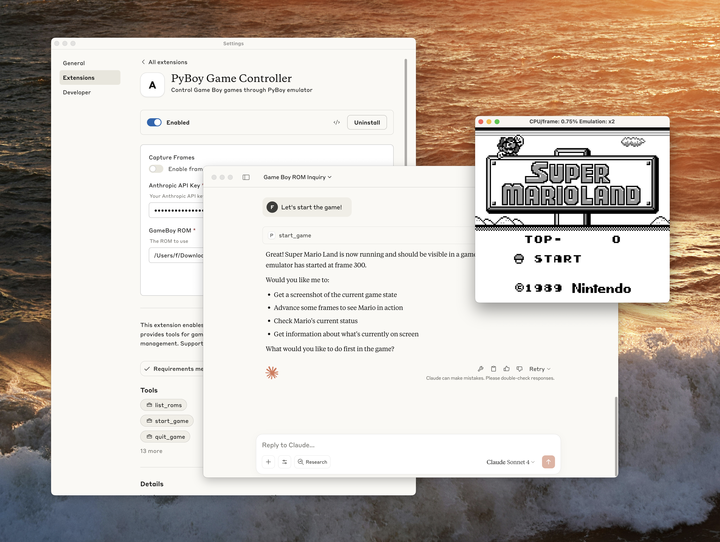
One team experimented to see how far our models could make it when directly connected to a GameBoy, similar to our “Claude plays Pokémon” research.
一个团队进行了实验,看看当我们的模型直接连接到 GameBoy 时能走到多远,类似于我们“Claude plays Pokémon”的研究。
We used Desktop Extensions to package a single extension that opens up the popular PyBoy GameBoy emulator and lets Claude take control.
我们使用 Desktop Extensions 打包了一个扩展,它打开了流行的 PyBoy GameBoy 模拟器,并让 Claude 取得控制权。
We believe that countless opportunities exist to connect the model’s capabilities to the tools, data, and applications users already have on their local machines.
我们相信,存在无数机会将模型的能力与用户本地机器上已有的工具、数据和应用程序连接起来。
We can't wait to see what you build.
我们迫不及待想看到你构建的东西。
The same creativity that brought us thousands of MCP servers can now reach millions of users with just one click.
曾经为我们带来数千个 MCP 服务器的同一种创造力,现在只需点击一次就能触达数百万用户。
Ready to share your MCP server?
准备好分享你的 MCP 服务器了吗?
Submit your extension for review.
提交你的扩展以供审核。