设计抗 AI 的技术评测
Designing AI-resistant technical evaluations
段落导航
Written by Tristan Hume, a lead on Anthropic's performance optimization team.
作者:Tristan Hume,Anthropic 性能优化团队的负责人。
Tristan designed—and redesigned—the take-home test that's helped Anthropic hire dozens of performance engineers.
Tristan 设计——并重新设计——了那套带回家测试(take-home test),它帮助 Anthropic 招聘了数十名性能工程师。
Evaluating technical candidates becomes harder as AI capabilities improve.
随着 AI 能力提升,评估技术候选人变得越来越难。
A take-home that distinguishes well between human skill levels today may be trivially solved by models tomorrow—rendering it useless for evaluation.
一套今天还能很好地区分人类技能水平的带回家测试,明天可能就会被模型轻松解决——从而在评估中失去作用。
Since early 2024, our performance engineering team has used a take-home test where candidates optimize code for a simulated accelerator.
自 2024 年初以来,我们的性能工程团队一直使用一套带回家测试,候选人需要为模拟加速器优化代码。
Over 1,000 candidates have completed it, and dozens now work here, including engineers who brought up our Trainium cluster and shipped every model since Claude 3 Opus.
已有超过 1,000 名候选人完成了它,其中数十人现在在这里工作,包括搭建我们的 Trainium 集群的工程师,以及自 Claude 3 Opus 以来交付每一个模型的工程师。
But each new Claude model has forced us to redesign the test.
但每一个新的 Claude 模型都迫使我们重新设计这套测试。
When given the same time limit, Claude Opus 4 outperformed most human applicants.
在相同时间限制下,Claude Opus 4 的表现超过了大多数人类申请者。
That still allowed us to distinguish the strongest candidates—but then Claude Opus 4.5 matched even those.
这仍让我们能区分出最强的候选人——但随后 Claude Opus 4.5 连这些最强候选人也追平了。
Humans can still outperform models when given unlimited time, but under the constraints of the take-home test, we no longer had a way to distinguish between the output of our top candidates and our most capable model.
在时间不限的情况下,人类仍然可以超过模型,但在带回家测试的限制下,我们再也无法区分顶尖候选人的产出和我们最强模型的产出。
I've now iterated through three versions of our take-home in an attempt to ensure it still carries signal.
我现在已经迭代了三版带回家测试,试图确保它仍然具有信号。
Each time, I’ve learned something new about what makes evaluations robust to AI assistance and what doesn't.
每一次,我都对什么能让评测(eval)对 AI 辅助保持稳健、什么不能,有了新的认识。
This post describes the original take-home design, how each Claude model defeated it, and the increasingly unusual approaches I've had to take to ensure our test stays ahead of our top model’s capabilities.
这篇文章描述了最初的带回家测试设计、每一个 Claude 模型如何攻破它,以及为了确保我们的测试始终领先于最强模型的能力,我不得不采取的越来越不寻常的方法。
While the work we do has evolved alongside our models, we still need more strong engineers—just increasingly creative ways to find them.
虽然我们所做的工作随着模型一起演进,我们仍然需要更多强大的工程师——只是需要用越来越有创意的方式找到他们。
To that end, we're releasing the original take-home as an open challenge, since with unlimited time the best human performance still exceeds what Claude can achieve.
为此,我们将原始的带回家测试作为公开挑战发布,因为在时间不受限的情况下,人类的最佳表现仍然超过 Claude 能达到的水平。
If you can best Opus 4.5, we’d love to hear from you—details are at the bottom of this post.
如果你能胜过 Opus 4.5,我们很乐意收到你的消息——详情见本文末尾。
In November 2023, we were preparing to train and launch Claude Opus 3.
2023 年 11 月,我们正准备训练并发布 Claude Opus 3。
We’d secured new TPU and GPU clusters, our large Trainium cluster was coming, and we were spending considerably more than we had in the past on accelerators, but we didn't have enough performance engineers for our new scale.
我们已经获得了新的 TPU 和 GPU 集群,我们的大型 Trainium 集群也即将到位,我们在加速器上的支出比过去多得多,但以我们新的规模,我们没有足够的性能工程师。
I posted on Twitter asking people to email us, which brought in more promising candidates than we could evaluate through our standard interview pipeline, a process that consumes significant time for staff and candidates
我在 Twitter 上发帖请人们给我们发邮件,这带来的有希望的候选人数量超过了我们通过标准面试流程所能评测的数量,而这一流程会消耗员工和候选人大量时间。
We needed a way to evaluate candidates more efficiently.
我们需要一种更高效地评测候选人的方式。
So, I took two weeks to design a take-home test that could adequately capture the demands of the role and identify the most capable applicants.
于是,我花了两周时间设计了一项带回家测试,它能够充分体现该职位的要求,并识别出最有能力的申请者。
Take-homes have a bad reputation.
带回家测试名声不好。
Usually they’re filled with generic problems which engineers find boring, and which make for poor filters.
通常它们充斥着工程师觉得无聊的通用问题,而且作为筛选方式效果很差。
My goal was different: create something genuinely engaging that would make candidates excited to participate and allow us to capture their technical skills at a high-level of resolution.
我的目标不同:创造一些真正吸引人的东西,让候选人兴奋地参与,并让我们能够高分辨率地捕捉他们的技术技能。
The format also offers advantages over live interviews for evaluating performance engineering skills:
这种形式在评测性能工程技能方面也比实时面试有优势:
Longer time horizon: Engineers rarely face deadlines of less than an hour when coding.
更长的时间跨度:工程师在编码时很少面临不到一小时的截止时间。
A 4-hour window (later reduced to 2 hours) better reflects the actual nature of the job.
4 小时的时间窗口(后来缩短为 2 小时)更好地反映了工作的实际性质。
It's still shorter than most real tasks, but we need to balance that with how onerous it is.
它仍然比大多数真实任务短,但我们需要在这一点与它的繁重程度之间取得平衡。
Realistic environment: No one watching or expecting narration.
真实的环境:没有人在旁边观看,也不期待有人口头叙述。
Candidates work in their own editor without distraction.
候选人可以在自己的编辑器中不受干扰地工作。
Time for comprehension and tooling: Performance optimization requires understanding existing systems and sometimes building debugging tools.
留出理解与构建工具的时间:性能优化需要理解现有系统,有时还需要构建调试工具。
Both are hard to realistically evaluate in a normal 50 minute interview.
这两点在通常 50 分钟的面试中都很难被真实地评估。
Compatibility with AI assistance: Anthropic's general candidate guidance asks candidates to complete take-homes without AI unless indicated otherwise.
与 AI 辅助的兼容性:Anthropic 面向候选人的通用指引要求候选人完成 take-home 时不要使用 AI,除非另有说明。
For this take-home, we explicitly indicate otherwise.
针对这次 take-home,我们明确说明情况相反。
Longer-horizon problems are harder for AI to solve completely, so candidates can use AI tools (as they would on the job) while still needing to demonstrate their own skills.
更长周期的问题更难让 AI 完整解决,因此候选人可以使用 AI 工具(就像在实际工作中那样),同时仍然需要展示自己的能力。
Beyond these format-specific goals, I applied the same principles I use when designing any interview to make the take-home:
除了这些针对特定形式的目标之外,我在设计这个 take-home 时还应用了设计任何面试时都会使用的相同原则:
Representative of real work: The problem should give candidates a taste of what the job actually involves.
能代表真实工作:题目应该让候选人初步体验这份工作实际涉及的内容。
High signal: The take-home should avoid problems that hinge on a single insight and ensure candidates have many chances to show their full abilities — leaving as little as possible to chance.
高信号(high signal):take-home 应该避免那些依赖于单一洞察的问题,并确保候选人有大量机会展示他们的全部能力——尽可能减少偶然性。
It should also have a wide scoring distribution,and ensure enough depth that even strong candidates don't finish everything.
它还应该有广泛的评分分布,并确保足够的深度,以至于即使是很强的候选人也不能完成所有内容。
No specific domain knowledge: People with good fundamentals can learn specifics on the job.
无需特定领域知识:具备良好基础的人可以在工作中学习具体细节。
Requiring narrow expertise unnecessarily limits the candidate pool.
要求狭窄的专业知识会不必要地限制候选人池。
Fun: Fast development loops, interesting problems with depth, and room for creativity.
有趣:快速的开发循环,有深度的有趣问题,以及发挥创造力的空间。
I built a Python simulator for a fake accelerator with characteristics that resemble TPUs.
我构建了一个用于模拟假想加速器的 Python 模拟器,其特性类似于 TPU。
Candidates optimize code running on this machine, using a hot-reloading Perfetto trace that shows every instruction, similar to the tooling we have on Trainium.
候选人优化在这台机器上运行的代码,使用热重载的 Perfetto 跟踪来显示每条指令,类似于我们在 Trainium 上拥有的工具。
The machine includes features that make accelerator optimization interesting: manually managed scratchpad memory (unlike CPUs, accelerators often require explicit memory management), VLIW (multiple execution units running in parallel each cycle, requiring efficient instruction packing), SIMD (vector operations on many elements per instruction), and multicore (distributing work across cores).
这台机器包含了一些特性,使得加速器优化变得有趣:手动管理的暂存内存(scratchpad memory;与 CPU 不同,加速器通常需要显式的内存管理)、VLIW(每个周期多个执行单元并行运行,需要高效的指令打包)、SIMD(每条指令对多个元素进行向量操作)以及多核(multicore;跨核心分配工作)。
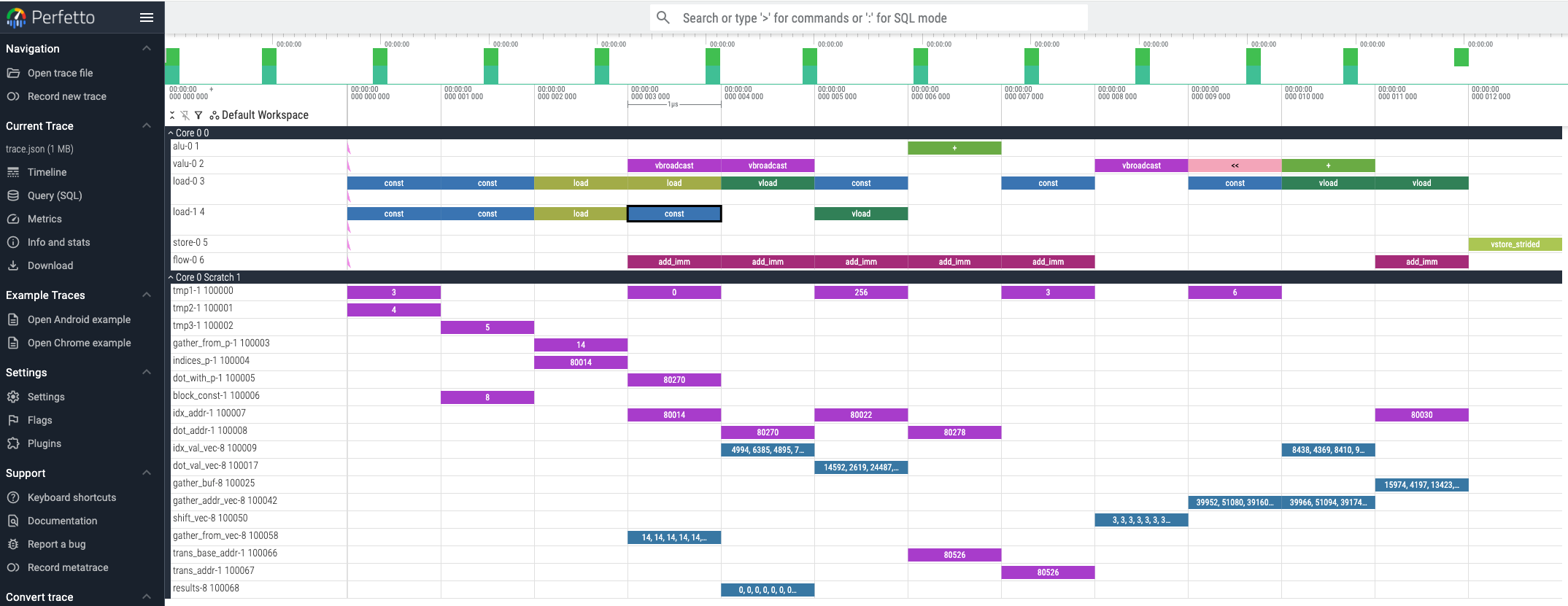
The task is a parallel tree traversal, deliberately not deep learning flavored, since most performance engineers hadn't worked on deep learning yet and could learn domain specifics on the job.
该任务是一个并行树遍历,刻意不带有深度学习色彩,因为大多数性能工程师尚未从事过深度学习,并且可以在工作中学习领域细节。
The problem was inspired by branchless SIMD decision tree inference, a classical ML optimization challenge as a nod to the past, which only a few candidates had encountered before.
该问题的灵感来自无分支 SIMD 决策树推断,这是一个经典的机器学习(ML)优化挑战,作为对过去的致敬,只有少数候选人以前遇到过。
Candidates start with a fully serial implementation and progressively exploit the machine's parallelism.
候选人从一个完全串行的实现开始,逐步利用机器的并行性。
The warmup is multicore parallelism, then candidates choose whether to tackle SIMD vectorization or VLIW instruction packing.
热身环节是多核并行,之后候选人选择是处理 SIMD 向量化还是 VLIW 指令打包。
The original version also included a bug that candidates needed to debug first, exercising their ability to build tooling.
原始版本还包含一个 bug,候选人需要先调试它,以此锻炼他们构建工具的能力。
The initial take-home worked well.
最初的 take-home test 效果很好。
One person from the Twitter batch scored substantially higher than everyone else.
来自 Twitter 那批人中的一个人得分显著高于其他所有人。
He started in early February, two weeks after our first hires through the standard pipeline.
他在 2 月初入职,比我们通过标准流程招到的第一批人晚了两个月。
The test proved predictive: He immediately began optimizing kernels and found a workaround for a launch-blocking compiler bug involving tensor indexing math overflowing 32 bits.
测试证明有预测力:他立即开始优化内核(kernel),并为一个阻碍发布的编译器 bug 找到了变通方法,该 bug 涉及张量索引运算溢出 32 位。
Over the next year and a half, about 1,000 candidates completed the take-home, and it helped us hire most of our current performance engineering team.
在接下来的一年半里,大约 1,000 名候选人完成了 take-home test,它帮助我们招聘了目前性能工程团队的大部分成员。
It proved especially valuable for candidates with limited experience on paper: several of our highest-performing engineers came directly from undergrad but showed enough skill on the take-home for us to hire confidently.
它对纸面经验有限的候选人尤其有价值:我们几位表现最好的工程师直接从本科毕业,但在 take-home test 上展现出足够的技能,让我们能够放心录用。
Feedback was positive.
反馈是正面的。
Many candidates worked past the 4-hour limit because they were enjoying themselves.
许多候选人超过 4 小时限制仍在继续,因为他们乐在其中。
The strongest unlimited-time submissions included full optimizing mini-compilers and several clever optimizations I hadn't anticipated.
最强的不限时提交包括完整的优化型迷你编译器,以及几个我未曾预料到的巧妙优化。
By May 2025, Claude 3.7 Sonnet had already crept up to the point where over 50% of candidates would have been better off delegating to Claude Code entirely.
到 2025 年 5 月,Claude 3.7 Sonnet 已经逐渐发展到这样的程度:超过 50% 的候选人如果完全委托给 Claude Code 反而会更好。
I then tested a pre-release version of Claude Opus 4 on the take-home.
然后我在 take-home test 上测试了一个预发布版本的 Claude Opus 4。
It came up with a more optimized solution than almost all humans did within the 4-hour limit.
它想出了一个比几乎所有人类在 4 小时限制内都更优的解决方案。
This wasn't my first interview defeated by a Claude model.
这不是我第一次被 Claude 模型击败的面试。
I'd designed a live interview question in 2023 specifically because our questions at the time were based around common tasks that early Claude models had lots of knowledge of and so could solve easily.
我在 2023 年专门设计了一道现场面试题,因为当时我们的题目围绕常见任务,早期 Claude 模型对此了解很多,因此能轻松解决。
I tried to design a question that required more problem solving skill than knowledge, still based on a real (but niche) problem I'd solved at work.
我试图设计一道更考验问题解决能力而非知识的题目,仍然基于我在工作中解决过的一个真实(但小众)问题。
Claude 3 Opus beat part 1 of that question; Claude 3.5 Sonnet beat part 2.
Claude 3 Opus 攻克了该题的第 1 部分;Claude 3.5 Sonnet 攻克了第 2 部分。
We still use it because our other live questions aren't AI-resistant either.
我们仍在使用它,因为我们的其他现场面试题同样不抗 AI。
For the take-home, there was a straightforward fix.
对于 take-home 测试,有一个直接的修复方法。
The problem had far more depth than anyone could explore in 4 hours, so I used Claude Opus 4 to identify where it started struggling.
这个问题的深度远超任何人能在 4 小时内探索完的程度,所以我用 Claude Opus 4 来找出它开始吃力的地方。
That became the new starting point for version 2.
这成为了版本 2 的新起点。
I wrote cleaner starter code, added new machine features for more depth, and removed multicore (which Claude had already solved, and which only slowed down development loops without adding signal).
我写了更清晰的起始代码,添加了新的机器特性以增加深度,并移除了 multicore(Claude 已经解决了它,而且它只会拖慢开发循环,不增加信号)。
I also shortened the time limit from 4 hours to 2 hours.
我还把时间限制从 4 小时缩短到了 2 小时。
I'd originally chosen 4 hours based on candidate feedback preferring less risk of getting sunk if they got stuck for a bit on a bug or confusion, but the scheduling overhead was causing multi-week delays in our pipeline.
我最初选择 4 小时,是基于候选人的反馈:他们更希望如果因某个 bug 或困惑而卡住一会儿,陷入困境的风险更低;但排期开销导致我们的流程出现数周的延迟。
Two hours is much easier to fit into a weekend.
两个小时更容易安排进一个周末。
Version 2 emphasized clever optimization insights over debugging and code volume.
版本 2 强调巧妙的优化洞见,而非调试和代码量。
It served us well—for several months.
它为我们服务得很好——持续了几个月。
When I tested a pre-release Claude Opus 4.5 checkpoint, I watched Claude Code work on the problem for 2 hours, gradually improving its solution.
当我测试一个预发布的 Claude Opus 4.5 检查点(checkpoint)时,我观察 Claude Code 在这个问题上工作了 2 小时,逐步改进它的解决方案。
It solved the initial bottlenecks, implemented all the common micro-optimizations, and met our passing threshold in under an hour.
它解决了最初的瓶颈,实现了所有常见的微优化,并在不到一小时内达到了我们的通过阈值。
Then it stopped, convinced it had hit an insurmountable memory bandwidth bottleneck.
然后它停了下来,确信自己遇到了无法克服的内存带宽瓶颈。
Most humans reach the same conclusion.
大多数人类也会得出同样的结论。
But there are clever tricks that exploit the problem structure to work around that bottleneck.
但有一些巧妙的技巧,可以利用问题的结构来绕过那个瓶颈。
When I told Claude the cycle count it was possible to achieve, it thought for a while and found the trick.
当我告诉 Claude 可能达到的周期数时,它思考了一会儿,找到了那个技巧。
It then debugged, tuned, and implemented further optimizations.
然后它进行调试、调优,并实现了进一步的优化。
By the 2-hour mark, its score matched the best human performance within that time limit—and that human had made heavy use of Claude 4 with steering.
到 2 小时结束时,它的得分已经在该时间限制内追平了最佳人类表现——而那个人类大量使用了 Claude 4 并配合引导(steering)。
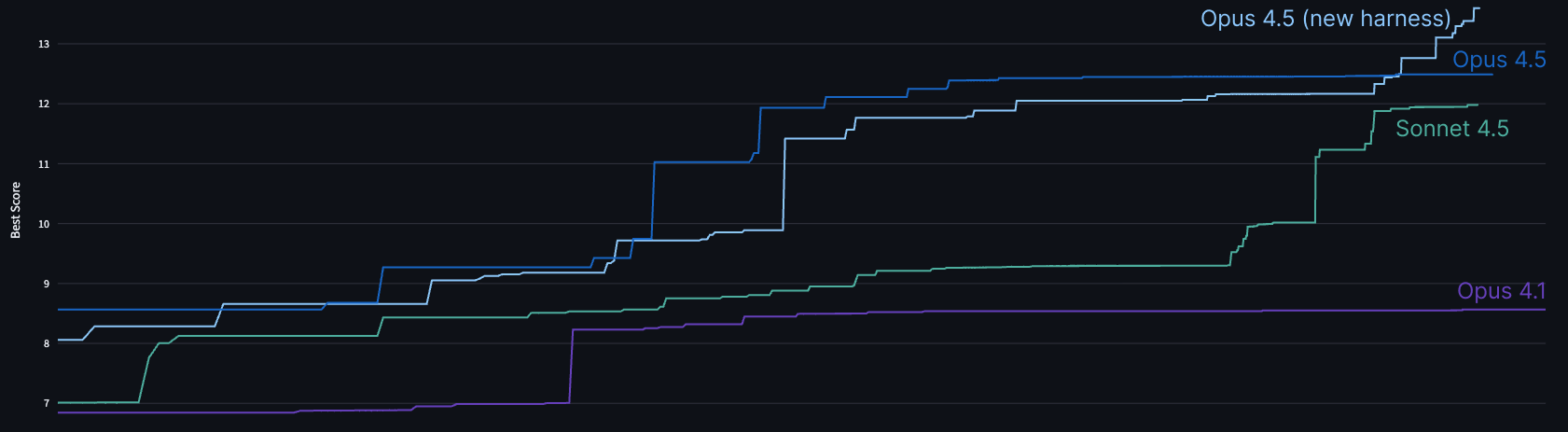
We tried it out in our internal test-time compute harness for more rigor and confirmed it could both beat humans in 2 hours and continue climbing with time.
我们在内部的测试时计算框架(harness)中试用了它,以求更严谨,并确认它既能在 2 小时内击败人类,又能随时间继续提升。
Post-launch we even improved our harness in a generic way and got a higher score.
发布后,我们甚至以通用方式改进了我们的框架,并获得了更高的得分。
I had a problem.
我遇到了一个问题。
We were about to release a model where the best strategy on our take-home would be delegating to Claude Code.
我们即将发布一个模型,而在我们的 take-home 测试中,最优策略会是把任务委托给 Claude Code。
Some colleagues suggested banning AI assistance.
一些同事建议禁止 AI 辅助。
I didn't want to do this.
我不想这么做。
Beyond the enforcement challenges, I had a sense that given people continue to play a vital role in our work, I should be able to figure out some way for them to distinguish themselves in a setting with AI—like they'd have on the job.
除了执行上的挑战之外,我有一种感觉:既然人仍在我们的工作中扮演关键角色,我就应该能想出某种办法,让他们在 AI 环境中脱颖而出——就像他们在工作中会面对的那样。
I didn't want to give in yet to the idea that humans only have an advantage on tasks longer than a few hours.
我还不想屈服于这样一种想法:人类只在耗时超过几小时的任务上才有优势。
Others suggested raising the bar to "substantially outperform what Claude Code achieves alone."
其他人建议把标准提高到“显著优于 Claude Code 单独取得的成果”。
The concern here was that Claude works fast.
这里的担忧在于 Claude 工作得很快。
Humans typically spend half the 2 hours reading and understanding the problem before they start optimizing.
人类通常会在 2 小时里花一半时间阅读并理解问题,然后才开始优化。
A human trying to steer Claude would likely be constantly behind, understanding what Claude did only after the fact.
一个试图引导 Claude 的人很可能始终落后,只能在事后才理解 Claude 做了什么。
The dominant strategy might become sitting back and watching.
占主导地位的策略可能会变成袖手旁观。
Nowadays performance engineers at Anthropic still have lots of work to do, but it looks more like tough debugging, systems design, performance analysis, figuring out how to verify the correctness of our systems, and figuring out how to make Claude's code simpler and more elegant.
如今 Anthropic 的性能工程师仍有很多工作要做,但工作内容更像是艰难的调试、系统设计、性能分析、弄清楚如何验证我们系统的正确性,以及弄清楚如何让 Claude 的代码更简单、更优雅。
Unfortunately these things are tough to test in an objective way without a lot of time or common context.
不幸的是,如果没有大量时间或共同语境,这些事情很难被客观地测试。
It's always been hard to design interviews that represent the job, but now it's harder than ever.
设计能代表实际工作的面试一直很难,但现在比以往任何时候都更难。
But I also worried if I invested in designing a new take-home, either Claude Opus 4.5 would solve that too, or it would become so challenging that it would be impossible for humans to complete in two hours.
但我也担心,如果我投入精力设计一个新的 take-home,要么 Claude Opus 4.5 也会把它解决掉,要么它会变得极具挑战性,以至于人类不可能在两小时内完成。
I realized Claude could help me implement whatever I designed quickly, which motivated me to try developing a harder take-home.
我意识到 Claude 能帮我快速实现我设计的任何东西,这促使我去尝试开发一个更难的 take-home。
I chose a problem based on one of the trickier kernel optimizations I'd done at Anthropic: an efficient data transposition on 2D TPU registers while avoiding bank conflicts.
我选择了一个问题,它基于我在 Anthropic 做过的一个比较棘手的 kernel 优化:在 2D TPU 寄存器上进行高效的数据转置,同时避免 bank conflicts。
I distilled it into a simpler problem on a simulated machine and had Claude implement the changes in under a day.
我把它提炼成模拟机器上的一个更简单的问题,并让 Claude 在不到一天内实现了这些改动。
Claude Opus 4.5 found a great optimization I hadn't even thought of.
Claude Opus 4.5 找到了一个我甚至没想到的绝佳优化。
Through careful analysis, it realized it could transpose the entire computation rather than figuring out how to transpose the data, and it rewrote the whole program accordingly.
通过仔细分析,它意识到可以转置整个计算,而不是去想办法转置数据,并据此重写了整个程序。
In my real case, this wouldn't have worked, so I patched the problem to remove that approach.
在我的真实场景中,这样做行不通,所以我修补了问题,移除了那种方法。
Claude then made progress but couldn't find the most efficient solution.
Claude 随后取得了进展,但未能找到最高效的解法。
It seemed like I had my new problem, now I just had to hope human candidates could get it fast enough.
看来我找到了我的新问题,现在只能希望人类候选人能足够快地解决它。
But I had some nagging doubt, so I double-checked using Claude Code's "ultrathink" feature with longer thinking budgets ... and it solved it.
但我有些挥之不去的疑虑,于是我用 Claude Code 的 "ultrathink" 功能,以更长的思考预算重新检查……结果它解决了。
It even knew the tricks for fixing bank conflicts.
它甚至知道修复存储体冲突(bank conflicts)的技巧。
In hindsight, this wasn't the right problem to try.
事后看来,这不是适合尝试的问题。
Engineers across many platforms have struggled with data transposition and bank conflicts, so Claude has substantial training data to draw on.
许多平台上的工程师都在数据转置和 bank conflicts 上挣扎过,因此 Claude 有大量训练数据可供借鉴。
While I'd found my solution from first principles, Claude could draw on a larger toolbox of experience.
虽然我是从第一性原理出发找到了解法,但 Claude 能借助更大规模的经验工具箱。
I needed a problem where human reasoning could win over Claude's larger experience base: something sufficiently out of distribution.
我需要一个人类推理能胜过 Claude 更庞大经验基础的问题:一个足够分布外(out of distribution)的问题。
Unfortunately, this conflicted with my goal of being recognizably like the job.
不幸的是,这与我想要让它明显像真实工作的目标相冲突。
I thought about the most unusual optimization problems I'd enjoyed and landed on Zachtronics games.
我回想自己最喜欢的最不寻常的优化问题,最终想到了 Zachtronics 游戏。
These programming puzzle games use unusual, highly constrained instruction sets that force you to program in unconventional ways.
这些编程解谜游戏使用不寻常且高度受限的指令集,迫使你以非传统方式编程。
For example, in Shenzhen I/O, programs are split across multiple communicating chips that each hold only about 10 instructions with one or two state registers.
例如,在 Shenzhen I/O 中,程序被拆分到多个相互通信的芯片上,每个芯片只容纳大约 10 条指令以及一两个状态寄存器。
Clever optimization often involves encoding state into the instruction pointer or branch flags.
巧妙的优化往往涉及把状态编码到指令指针或分支标志中。
I designed a new take-home consisting of puzzles using a tiny, heavily constrained instruction set, optimizing solutions for minimal instruction count.
我设计了一个新的 take-home,由使用极小且高度受限指令集的谜题组成,要求优化解法以达到最少指令数。
I implemented one medium-hard puzzle and tested it on Claude Opus 4.5.
我实现了一个中等偏难的谜题,并在 Claude Opus 4.5 上测试。
It failed.
它失败了。
I filled out more puzzles and had colleagues verify that people less steeped in the problem than me could still outperform Claude.
我补充了更多谜题,并让同事验证:对这个问题不如我熟悉的人仍然能胜过 Claude。
Unlike Zachtronics games, I intentionally provided no visualization or debugging tools.
与 Zachtronics 游戏不同,我特意没有提供可视化或调试工具。
The starter code only checks whether solutions are valid.
起始代码只检查解决方案是否有效。
Building debugging tools is part of what's being tested: you can either insert well-crafted print statements or ask a coding model to generate an interactive debugger in a few minutes.
构建调试工具本身就是被测试内容的一部分:你可以插入精心设计的 print 语句,也可以让编码模型在几分钟内生成一个交互式调试器。
Judgment about how to invest in tooling is part of the signal.
关于如何投入工具建设的判断也是信号的一部分。
I'm reasonably happy with the new take-home.
我对新的 take-home 还算满意。
It might have lower variance than the original because it comprises more independent sub-problems.
它可能比原版方差更低,因为它包含更多相互独立的子问题。
Early results are promising: scores correlate well with the caliber of candidates' past work, and one of my most capable colleagues scored higher than any candidate so far.
早期结果很有希望:分数与候选人过往工作的水准相关性很好,而且我最能干的一位同事得分比迄今为止的任何候选人都高。
I'm still sad to have given up the realism and varied depth of the original.
我仍然为放弃了原版的真实感和多样层次而感到遗憾。
But realism may be a luxury we no longer have.
但真实感可能已是我们不再拥有的奢侈品。
The original worked because it resembled real work.
原版之所以有效,是因为它像真实工作。
The replacement works because it simulates novel work.
替代版之所以有效,是因为它模拟的是新颖工作。
We're releasing the original take-home for anyone to try with unlimited time.
我们将发布原版 take-home,供任何人在不限时间的情况下尝试。
Human experts retain an advantage over current models at sufficiently long time horizons.
在足够长的时间尺度上,人类专家相对于当前模型仍保持优势。
The fastest human solution ever submitted substantially exceeds what Claude has achieved even with extensive test-time compute.
有史以来提交的最快人类解决方案,大幅超过 Claude 即使在大量测试时计算(test-time compute)下所达到的水平。
The released version starts from scratch (like version 1) but uses version 2's instruction set and single-core design, so cycle counts are comparable to version 2.
发布版本从零开始(像版本 1 一样),但使用版本 2 的指令集和单核设计,因此周期计数与版本 2 相当。
Performance benchmarks (measured in clock cycles from the simulated machine):
性能基准(以模拟机器的时钟周期计量):
2164 cycles: Claude Opus 4 after many hours in the test-time compute harness
2164 周期:Claude Opus 4 在 test-time compute 框架中运行数小时后
1790 cycles: Claude Opus 4.5 in a casual Claude Code session, approximately matching the best human performance in 2 hours
1790 周期:Claude Opus 4.5 在一次随意的 Claude Code 会话中完成,大致相当于人类 2 小时的最佳表现
1579 cycles: Claude Opus 4.5 after 2 hours in our test-time compute harness
1579 周期:Claude Opus 4.5 在我们的 test-time compute 框架中运行 2 小时后
1548 cycles: Claude Sonnet 4.5 after many more than 2 hours of test-time compute
1548 周期:Claude Sonnet 4.5 经过远超 2 小时的 test-time compute 后
1487 cycles: Claude Opus 4.5 after 11.5 hours in the harness
1487 周期:Claude Opus 4.5 在该框架中运行 11.5 小时后
1363 cycles: Claude Opus 4.5 in an improved test time compute harness after many hours
1363 周期:Claude Opus 4.5 在改进后的 test-time compute 框架中运行数小时后
Download it on GitHub.
在 GitHub 上下载它。
If you optimize below 1487 cycles, beating Claude's best performance at launch, email us at performance-recruiting@anthropic.com with your code and a resume.
如果你能优化到低于 1487 个周期,超越 Claude 在发布时的最佳表现,请把你的代码和简历发到 performance-recruiting@anthropic.com。
Or you can apply through our typical process, which uses our (now) Claude-resistant take-home.
或者你也可以走我们常规的申请流程,它使用的是我们(如今)能抵御 Claude 的 take-home 测试。
We're curious how long it lasts.
我们很好奇它还能撑多久。